Anyone learning medical terminology will benefit from quick-reference, laminated guides, and compact flash cards. This article highlights five practical options that work for beginners, nursing students, medical coders, and allied health trainees. Each pick is evaluated for clarity, portability, and how well it supports rapid word-building and test preparation. The buyers best suited are highlighted to help you choose efficiently.
Summary table of selected products
| Product | Best For | Format and Use | |
|---|---|---|---|
| Medical Terminology: The Basics — QuickStudy Laminated Reference Guide | Beginner students needing foundational terms | Laminated quick-reference | Foundational word structure and glossary in a compact chart |
| Anatomy Terminology Reference Guide — QuickStudy | Visual learners focusing on body terminology | Laminated reference | Focused anatomy terminology for quick recall |
| Medical Terminology: The Body — QuickStudy | Body-system oriented study | Laminated reference | Body-focused terminology reference |
| Medical Terminology Cheat Sheet — SwiftPass | Nursing students and medical coders | One-page cheat sheet | Extensive prefixes, suffixes, root words and examples on a single sheet |
| Nursing School Essentials Medical Terminology Flash Cards — Level Up RN | Active study and memorization | Flash cards (159 cards plus extras) | Focused terms with memorization tips and illustrations |
The following sections review each product in detail, including who it’s best for, why it fits into a study plan, and any limitations to consider.
Medical Terminology Basics: QuickStudy Laminated Guide
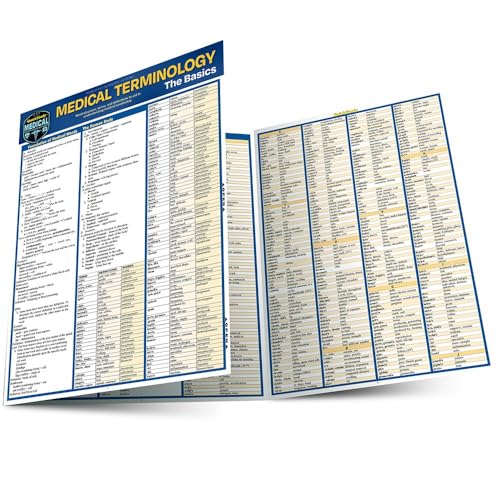
This compact chart provides the foundation of medical word parts, the human body overview, terminology sets, the five senses, a glossary, and key synonyms. Best for beginners who need a concise, portable reference during study sessions or clinical shadowing. It supports quick word-building checks and basic term recall in a single sheet, which aids fast lookup during exams or practice questions.
Best for: students just starting medical terminology who want a straightforward, all-in-one reference. Limitation: may lack in-depth explanations for advanced terms or coding contexts.
Anatomy Terminology Reference Guide

Designed for visual learners, this laminated reference centers on anatomy-specific terminology. It’s a compact resource ideal for quick review between classes or lab sessions. It works well for students who need to connect term names with the body’s regions and systems.
Best for: learners who prefer anatomy-focused shorthand and memory cues. Limitation: available as a used book in good condition, which may affect availability or pricing consistency.
Medical Terminology: The Body

Focused on body systems, this laminated reference supports terminology tied to anatomy and clinical contexts. It is best for students who want to learn terms in the context of bodily functions and physiological regions. It complements broader medical terminology study with system-specific detail.
Best for: those studying pathology or physiology in parallel with terminology. Limitation: condition noted as used; availability and condition may vary by seller.
Medical Terminology Cheat Sheet — SwiftPass

This one-page cheat sheet packs more than 1,000 terms and examples, along with prefixes, suffixes, root words, and a medical abbreviations chart. It is organized by body system, which helps coders and students preparing for exams that use system-based terminology. Best for: nursing students, medical coders, and pre-med learners who need quick access to many terms in one place.
Caution: as a compact reference, it may not replace broader study materials needed for deeper understanding or comprehensive exams.
Nursing School Essentials Medical Terminology Flash Cards
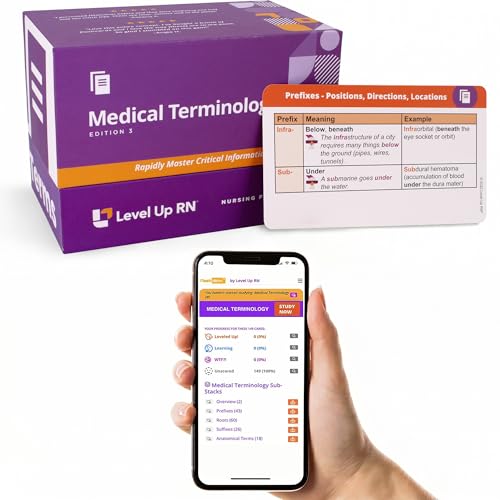
These flash cards cover 559 essential prefixes, roots, suffixes, and key terms, with 397 examples and memorization tips. They group related concepts to reduce confusion and support long-term retention. Best for: nursing students, EMTs, and medical coding students who benefit from active recall and spaced repetition.
Limitation: flash cards require ongoing practice, which may be less convenient for quick on-the-go checks without a study session plan.
Buying Guide
What format best fits your study style?
Laminated guides are ideal for quick lookups in hands-on settings, while flash cards support active recall and spaced repetition. For classroom or lab use, laminated sheets can stay open on a desk, while cards travel easily in a bag or pocket.
How deep should the content go?
If you are beginning, start with foundational word parts and body system terminology (as in the QuickStudy basics). If you are advancing, choose resources with anatomy focus or a cheat sheet that includes prefixes, suffixes, and root words with examples.
Who is the primary user?
For pre-med and allied health students, tools that present terms by body system and provide concise explanations work best. For nursing students and coders, a one-page cheat sheet with examples can accelerate exam preparation. For visual learners, anatomy-focused guides paired with illustrations are especially effective.
How should you balance breadth and practicality?
Use a mix: a laminated general terminology reference for daily use, a body-focused guide for context, and flash cards for memorization. This combination supports both recognition and recall under test conditions.
What should you avoid if you want portability?
Avoid bulky tomes when you need quick reference in clinical settings. Laminated sheets and compact flash cards typically offer superior portability and durability in busy environments.
FAQ
- Q: Are laminated references durable for daily use?
- A: Yes. Laminated guides resist moisture and wear, making them reliable for on-the-go study and clinical settings.
- Q: Is a one-page cheat sheet enough for serious study?
- A: It’s a practical quick-reference and exam aid, but should be supplemented with broader study materials for in-depth understanding.
- Q: Who benefits most from flash cards?
- A: Learners who rely on active recall and spaced repetition, especially for memorizing prefixes, roots, and suffixes.
- Q: Should I choose system-based terms or general terminology?
- A: System-based terms help with clinical reasoning, while general terminology supports foundational word-building. A blended approach is effective.
- Q: Can these tools replace formal coursework?
- A: No. They are study aids designed to supplement coursework, practice, and exam preparation.