The best solar system learning resources make planets easier to explore through hands-on play, visual demonstrations, or guided activities. The Giant Inflatable Solar System is best for showing planetary scale, while the Giant Magnetic Solar System helps with classroom demonstrations. The Skill Builder Outer Space Activity Set suits preschool practice, the Solar System Puzzle Globe adds a build-and-play activity, and the Primary Science Shining Stars Projector supports visual exploration.
| Resource | Best For | Learning Style |
|---|---|---|
| Giant Inflatable Solar System | Showing planet sizes and scale | Large, tactile model |
| Giant Magnetic Solar System | Group lessons and sequencing | Whiteboard demonstration |
| Skill Builder Outer Space Activity Set | Preschool activities | Writing, puzzles, and building |
| Solar System Puzzle Globe | Hands-on individual play | 3-D puzzle and imaginative play |
| Primary Science Shining Stars Projector | Visual space exploration | Projected images |
Giant Inflatable Solar System

Best for: Teachers and families who want a large, tactile model for discussing planets and relative size. The inflatable planets range from 5 to 36 inches in diameter, giving learners a visible way to compare their different scales.
The set includes all eight planets, Pluto, the Sun, Earth’s Moon, a foot pump, repair patches, and an activity guide. Its washable planets can be used for classroom demonstrations or home learning, making it a flexible choice for group activities and repeated lessons.
Why it stands out: The range of planet sizes supports visual comparisons, while the included guide offers a starting point for activities. Consider: The planets need to be inflated, so this set requires more setup and storage space than small tabletop resources.
Giant Magnetic Solar System
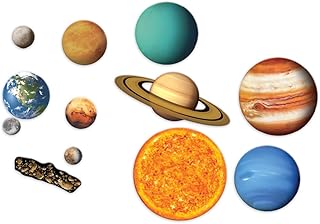
Best for: Educators or families who want to arrange and discuss solar system objects on a magnetic surface. The 12-piece set features NASA satellite images of the planets, Sun, Moon, asteroid belt, and Pluto.
The large magnets are designed for whiteboards, metal doors, and other magnetic surfaces. They can support lessons about planetary order and size comparisons, as well as activities that build sequencing skills. This makes the set better suited to demonstrations and shared learning than to a take-along activity book.
Why it stands out: Learners can move the pieces while working through planet order, which makes the lesson interactive. Consider: The magnetic format depends on having a suitable magnetic surface; it is less useful for learners who need a standalone model.
Skill Builder Outer Space Activity Set
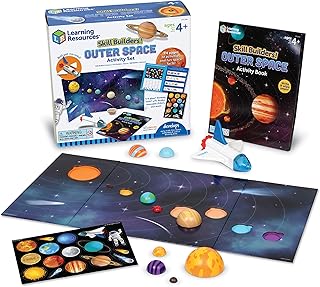
Best for: Preschool learners who benefit from short, varied activities alongside early science practice. The set covers the order of the planets and includes a 24-page write-and-wipe activity book with mazes, writing exercises, sequencing tasks, and space facts.
Children can also build a 3-D rocket and use its secret-message decoder. The combination of reading, writing, problem-solving, and construction makes this a better choice for structured learning than a display-only resource.
Why it stands out: The activities connect space topics with school-ready skills, while the reusable write-and-wipe format supports repeat practice. Consider: This is an activity-focused set, not a large visual model for demonstrating planet scale to a group.
Solar System Puzzle Globe

Best for: Young children who enjoy building and imaginative play while encountering space themes. This 3-D puzzle is designed to help develop fine motor skills, and it comes with an astronaut and spaceship for pretend adventures across the solar system.
The globe also has a glow-in-the-dark feature: the astronaut and constellations glow when the lights are off. That detail can extend the play into a room-display experience after the puzzle activity.
Why it stands out: It combines a hands-on puzzle with pretend-play accessories and a visual glow feature. Consider: The listed features emphasize puzzle building and imaginative exploration rather than detailed planet-size comparisons or a guided curriculum.
Primary Science Shining Stars Projector

Best for: Young learners who respond to visual demonstrations of space. The projector beams images of stars, planets, space walks, and more onto a surface, allowing children to look at the images up close or project them across a room.
The activity can prompt conversations about space and support language development and cause-and-effect exploration. Choose this resource if you want a visual complement to books or hands-on models, rather than a set for arranging planets in order.
Why it stands out: Projected images can make space topics more visually engaging without relying on a physical planet model. Consider: The listed features focus on projecting images; they do not describe planet-size comparisons or written activities.
Buying Guide: Choosing A Solar System Learning Resource
Which format fits the learning space?
For a classroom or a group demonstration, consider the inflatable planets or magnetic pieces. The inflatable set gives learners objects of different diameters to compare, while the magnetic set makes it possible to arrange planets on a board. For a smaller activity area, a puzzle, activity book, or projector may be easier to incorporate.
Do you want active practice or visual exploration?
Choose the Skill Builder set for writing, mazes, sequencing, and construction. Select the Puzzle Globe for puzzle building and imaginative play. The projector is a better fit when the goal is to display space images and start visual discussion. These resources offer different learning experiences, so consider whether the child learns best by making, moving, writing, or looking.
What should you check before choosing?
- Available space: Large inflatable planets need more room to use and store than compact activities.
- Learning goal: Use size-focused models for comparison, magnetic pieces for ordering, and activity pages for skill practice.
- Group size: Large models and board magnets are suited to demonstrations; a puzzle or activity set may better suit individual work.
- Age and support: Match the activity type to the learner’s abilities and whether an adult will guide the lesson.
Frequently Asked Questions
Which resource is best for teaching planet size?
The Giant Inflatable Solar System is the clearest choice for visual size comparisons because its planets range from 5 to 36 inches in diameter.
Which option is best for practicing planet order?
The Giant Magnetic Solar System supports arranging planets on magnetic surfaces, while the Skill Builder set includes sequencing exercises in its activity book.
Which solar system resource is designed for preschool activities?
The Skill Builder Outer Space Activity Set is specifically described as offering preschool science activities, including a write-and-wipe book and a 3-D rocket.
Which product includes a glow-in-the-dark feature?
The Solar System Puzzle Globe has an astronaut and constellations that glow in the dark.
Can the projector teach planetary scale?
The listed projector features describe projected space images, not planet-size comparisons. For scale demonstrations, consider the inflatable planet set instead.