The best elementary homeschool history resource depends on your child’s grade, interests, and preferred approach. These five books cover state geography, ancient civilizations, U.S. history, and broader fifth-grade social studies practice. The Exploring America workbook is best for learning about all 50 states; the ancient civilizations book suits readers interested in early world history; and the grade-level workbooks are better fits for older elementary students who can handle more advanced material. Check each book’s grade range and scope before choosing it as a full curriculum.
| Resource | Best For | Primary Focus |
|---|---|---|
| Exploring America | Elementary learners exploring the states | Geography, state facts, capitals, and history |
| Mark Twain U.S. History Workbook | Older students | U.S. history from 1865 to the present |
| U.S. History Workbook for Grades 5–8 | Upper elementary and middle school | Beginnings through Reconstruction |
| Ancient Civilizations of the World | Kids beginning world history | Mesopotamia, Egypt, Greece, and Rome |
| 180 Days: Social Studies for Fifth Grade | Fifth graders needing regular practice | Social studies activities and assessment |
Exploring America Geography Workbook

This workbook combines U.S. geography with state-related history and activities. Its title identifies coverage of all 50 states and capitals, along with fact-filled activities and coloring. That mix can give elementary learners a concrete way to connect places, state names, and historical information.
Best for: Children who are beginning to study U.S. geography or enjoy activity-based learning. Choose this if you want a state-by-state resource that includes more than map or capital memorization. It may also work as a supplemental unit alongside a broader history plan.
Limitation: The listed title emphasizes geography and state facts, so it should not be treated as a complete chronological U.S. history curriculum without checking the book’s contents.
Mark Twain U.S. History Workbook
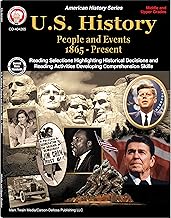
This Mark Twain workbook covers people and events from 1865 to the present day. The product description identifies it as a middle school resource for social studies classrooms and homeschool use. Its defined time span makes it a possible follow-on after a child has studied earlier U.S. history.
Best for: Older elementary students ready for middle-school-level work, or homeschoolers who want a focused study of U.S. history after the Civil War. Choose this if your child needs practice with later historical periods rather than colonial or early American history.
Limitation: The listed audience is middle school, and the coverage starts in 1865. It is not the strongest match for younger elementary learners or families seeking a complete survey from the earliest periods onward.
U.S. History Workbook for Grades 5–8

This workbook is titled for grades 5–8 and covers U.S. history from the beginnings through Reconstruction. The stated scope makes it a structured option for learners studying early American history, with a stopping point that can help families plan a later unit on subsequent periods.
Best for: Upper elementary students, especially those in fifth grade or above, who are ready for a middle-school-oriented history workbook. Choose it if the current goal is to cover early U.S. history through Reconstruction rather than world history or state geography.
Limitation: Its grade range may be advanced for younger elementary children, and the stated coverage does not extend beyond Reconstruction. Families will need additional material for later U.S. history.
Ancient Civilizations of the World

This reading book focuses on four ancient civilizations: Mesopotamia, Egypt, Greece, and Rome. Its title presents it as a homeschooling history resource for kids, so it may be used to introduce major ancient societies before moving into more detailed study or related activities.
Best for: Elementary learners who are curious about ancient history and families building a world-history unit. Choose this if you want a reading-based resource rather than a workbook centered on U.S. states or modern history.
Limitation: The listed title names four civilizations, so it does not indicate coverage of the full range of world history. Review the reading level and contents to determine whether it suits your child’s age and learning needs.
180 Days: Social Studies for Fifth Grade

This fifth-grade resource is titled “Practice, Assess, Diagnose,” indicating an emphasis on recurring practice and checking student understanding. It is a social studies book rather than a history-only title, which may suit families looking to include history within a wider subject routine.
Best for: Fifth graders who benefit from regular, structured social studies practice. Choose this if you want a resource organized around ongoing work and assessment rather than a single historical era.
Limitation: The title does not specify a particular history timeline or list its topic coverage. It may not provide the chronological depth needed as a standalone history course.
Buying Guide: How to Choose a Homeschool History Resource
What grade level should you choose?
Start with the age and reading ability of the student, then compare those needs with the stated grade range. The fifth-grade and grades 5–8 workbooks are more clearly aimed at older learners. For younger children, consider whether a resource’s reading and writing demands are manageable; a topic that interests a child can still be challenging if the text is too advanced.
Do you need U.S. history, world history, or geography?
Choose by learning goal. Exploring America focuses on U.S. states and geography, while the ancient civilizations book introduces a selection of early world societies. The two U.S. history workbooks cover different periods: one spans beginnings through Reconstruction, and the other focuses on 1865 to the present. The fifth-grade social studies book may offer broader subject practice, but its exact history scope should be confirmed.
Can a workbook serve as a complete curriculum?
A workbook can organize practice, but a single book may not cover every period or skill your homeschool plan requires. Compare its stated time span and topics with your goals. You may need supplementary reading, maps, discussion, or additional materials to fill gaps, especially when a resource covers only one era or a limited set of civilizations.
Should you choose reading or activity-based learning?
Consider how your child engages with new information. A reading book can support learning through narrative and explanation, while an activity workbook may offer practice through questions, facts, or coloring. A mix can help balance reading, recall, and applied geography. Check the book description and sample pages when available to assess the format.
Frequently Asked Questions
What is a good history resource for elementary homeschoolers studying all 50 states?
Exploring America is the clearest match in this list because its title identifies all 50 states, capitals, geography, history, activities, and coloring.
Which book covers ancient civilizations?
Ancient Civilizations of the World focuses on Mesopotamia, Egypt, Greece, and Rome.
Which U.S. history workbook covers Reconstruction?
The U.S. History Workbook for Grades 5–8 is titled to cover U.S. history from the beginnings through Reconstruction.
Which resource focuses on U.S. history after 1865?
The Mark Twain U.S. History Workbook covers people and events from 1865 to the present day.
Is 180 Days: Social Studies for Fifth Grade a history-only book?
No. Its title identifies it as a fifth-grade social studies practice, assessment, and diagnostic resource, not as a history-only workbook.