Shopper intent: find reliable barcode scanners ideal for library use, prioritizing portability, 2D and 1D decoding, and flexible wireless connections. This guide highlights five scanners suited for librarians, booksellers, and staff who need quick, accurate checkout and inventory tasks. Each option supports common library barcodes, with features designed for durability and easy data transfer to library systems. Best fits include handheld and pocket designs for desk work, carts, or on-the-go shelf checks.
Summary table of selected products:
| Product | Connection | Best For |
|---|---|---|
| Eyoyo Mini 1D Bluetooth Barcode Scanner | 3-in-1 (2.4G, Bluetooth, USB) | Small, portable libraries, on-the-go inventory |
| PecuMecu Bluetooth 2D Barcode Scanner (TM-10B) | 3-in-1 (2.4G, Bluetooth, USB) | 2D codes and mixed device environments |
| NetumScan Desktop Barcode Scanner | Wired USB, auto-sensing | Desk-based checkout and high-volume scanning |
| ScanAvenger Wireless Portable 1D&2D | 3-in-1 (wireless, Bluetooth, USB) | Inventory in carts or shelving with stand |
| PecuMecu Bluetooth 1D&2D Barcode Scanner (TM-10B) | 3-in-1 (2.4G, Bluetooth, USB) | Flexible deployment across devices |
Eyoyo Mini 1D Bluetooth Barcode Scanner

Best for ultra-portable scanning in libraries, the Eyoyo Mini 1D scanner weighs about 35 g and fits easily in a pocket. It supports 2.4G wireless, Bluetooth, and USB wired modes, enabling desk work or mobile shelf checks. Its 1D decoding covers UPC/EAN, Code 39, and more, including damaged or reflective barcodes commonly found on library items. Choose this if you need a tiny, flexible scanner for quick checks at the desk or on a cart. Caution: 1D-only decoding means 2D codes will not be scanned unless paired with a device that handles them, so use where 1D barcodes are standard.
Best for: librarians who value compact design and multi-mode connectivity for varied work scenarios. Why selected: portability and three connection options reduce hardware changes across tasks.
Key features:
- Mini pocket size, 35 g light
- 3-in-1: 2.4G, Bluetooth, USB wired
- Wide 1D decoding support including damaged barcodes
PecuMecu Bluetooth 2D Barcode Scanner, 3-in-1

Best for mixed code environments, the PecuMecu 2D scanner decodes 1D and 2D codes, including QR, DataMatrix, and more. It offers 3-in-1 connections with ranges up to 70 m in 2.4G mode and 20 m in Bluetooth mode. This makes it suitable for libraries that need flexible pairing with laptops, tablets, or POS systems. Not compatible with Square; consider alternatives if Square is part of your workflow. Caution: ensure your library software supports 2D decoding in your current setup.
Best for: libraries handling diverse barcode formats and multiple devices. Why selected: broad code compatibility and long-range wireless options support extensive inventories.
Key features:
- 1D and 2D decoding (QR, DataMatrix, etc.)
- 3-in-1 connection: 2.4G, Bluetooth, USB
- Wide compatibility with Windows, Mac OS, Linux
NetumScan Desktop Barcode Scanner, USB

Best for desk-based library workflows with high scan throughput, the NetumScan desktop scanner supports omnidirectional scanning of 1D and 2D/barcodes on labels and displays. It auto-senses and goes into sleep mode when idle, ready to wake on movement. Its anti-slip base and IP54 protection add durability in busy library workspaces. Use this when you need reliable, hands-free or stand-supported scanning at a checkout desk or in processing areas. Caution: designed for stationary use; mobility is limited compared to handheld options.
Best for: staff performing long reading-room or circulation desk tasks. Why selected: smart sensing and durable build suit high-volume environments.
Key features:
- Omnidirectional scanning of 1D/2D codes
- Automatic wake/sleep with intelligent sensing
- Non-slip base and IP54 protection
ScanAvenger Wireless Portable 1D&2D with Stand
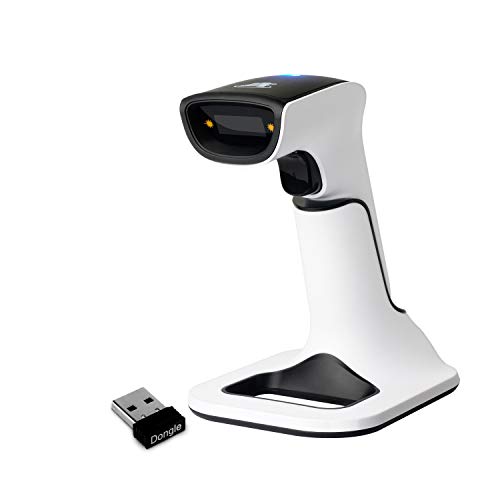
Best for inventory tasks on the go, the ScanAvenger combines 1D and 2D decoding in a handheld form with a next-generation stand for easy charging and data transmission. It operates without software installation and can connect via wireless, Bluetooth, or USB. The stand enables convenient charging and transmission, making it suitable for librarians who need a reliable, recharge-and-scan workflow during shelf checks or cart-based inventory. Caution: support may vary with proprietary system integrations; confirm compatibility with your library software.
Best for: libraries that require a mobile scanner with a smart charging stand. Why selected: flexible 3-in-1 connectivity plus stand-based charging improves workflow efficiency.
Key features:
- No software needed for most systems
- Next-gen charging stand for wireless data transfer and charging
- 3-in-1 connectivity
PecuMecu Bluetooth 1D&2D Barcode Scanner (TM-10B)
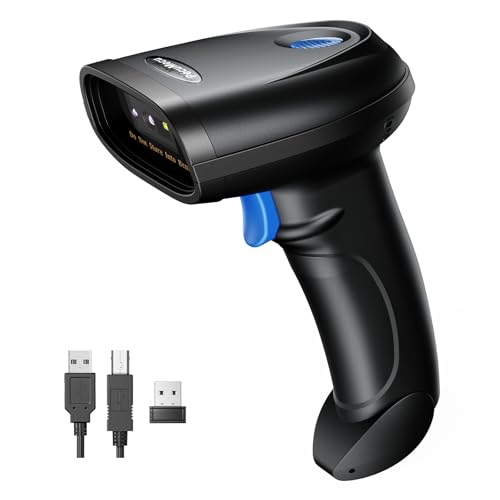
Best for flexible deployment across devices, the PecuMecu TM-10B handles both 1D and 2D codes with 3-in-1 connectivity. It supports a wide range of operating systems and is suitable for libraries using Windows, Android, iOS, or Mac environments. If your workflow includes QR codes and standard 1D barcodes, this scanner provides a balanced option. Caution: Square compatibility is noted as an exception in some specs; verify compatibility with your payment or cataloging software before purchase.
Best for: libraries needing a versatile, cross-platform scanner. Why selected: strong 2D decoding with broad OS support and multi-mode connections.
Buying Guide
- What code types do you primarily scan? If you mostly handle 1D barcodes, a compact 1D scanner may suffice. For libraries with QR and DataMatrix items, choose a 2D-capable model.
- What workflow do you need? Desktop stations favor USB or wired options with auto-sensing. Mobile shelves or carts benefit from 3-in-1 wireless capabilities and long-range transmission.
- How important is form factor? Pocket-sized scanners excel at quick checks, while desktop scanners handle high-volume tasks with stability.
- Do you require software-free operation? Some models work without extra software, streamlining deployment in diverse IT environments.
- Is compatibility with specific systems important? Confirm OS support (Windows, Mac OS, Linux, iOS, Android) and app-level compatibility for your library software.
- Battery life and standby features matter for daily rounds. Look for long battery life and smart sleep modes to maximize uptime.
Quick comparison by use case
- On-the-go shelving: Eyoyo Mini 1D or Eyoyo Portable Mini 2D (Bluetooth) — best for pocket use and quick checks.
- Desk circulation desk: NetumScan Desktop — best for high-volume, stationary scanning with reliability.
- Mixed code formats: PecuMecu 2D solutions — best for 2D and 1D codes across multiple devices.
- Inventory in carts: ScanAvenger with stand — best for stand-based charging and stand-mounted workflow.
FAQ
Do these scanners work with library software systems?
Most models are designed to connect via USB, Bluetooth, or wireless and can input data into standard library software that accepts keyboard input or barcode data. Check OS compatibility and whether your library system requires specific drivers.
Are 2D scanners necessary for libraries?
Not always, but 2D scanners can read QR codes or DataMatrix items that appear in modern catalogs, author promotions, or digital-access cards. They offer greater versatility.
Is a wireless scanner better for shelf checks?
Yes, 3-in-1 wireless models provide mobility for scanned shelf checks, inventory walks, and cart-based workflows without cords.
What about durability and warranty?
Durability varies by model. Look for ergonomic, drop-resistant builds if devices are frequently moved or dropped during routine tasks. Always verify the manufacturer’s warranty terms with the seller.
Can I scan damaged barcodes?
Many modern scanners include advanced decoding that handles damaged or distorted barcodes, a common issue in busy library environments.